Why Clutter Feels Heavy
What our surroundings may be asking of our attention
By Dr. Punam Rana MD MSc • Medical Oncologist & Mindfulness Educator

Most of us know the feeling of opening a packed closet and feeling a little tired before we’ve even chosen what to wear. Or walking into a room filled with things and immediately wanting to walk back out.
We tend to think of clutter as an organizational problem. We need better storage, more time, or perhaps more discipline.
But our physical surroundings also place demands on our attention. Research suggests that how we experience our homes may be connected to how stressed we feel within them.
As a medical oncologist and certified mindfulness teacher, I spend much of my working life thinking about stress, attention, and the ways our bodies respond to the environments around us. Recently, decluttering my own home made me think about a source of mental load I had largely overlooked: the things I own.
What the Research Says About Clutter and Stress
One interesting study came from researchers at UCLA, who studied 30 dual-income families. The researchers asked couples to give tours of their homes, paying attention to the language they used to describe their living spaces. They also measured cortisol, one of the hormones involved in the body’s stress response, over several days.
Among the women in the study, describing the home as more stressful, including using more language related to clutter and unfinished projects, was associated with a flatter decline in cortisol throughout the day. Those with higher stressful-home scores also reported worsening mood over the course of the day.
The study was small and observational, so it cannot tell us that clutter itself caused these changes. But it raises an interesting possibility: the way we experience our physical surroundings may be connected to the way we experience stress.
Research on visual attention offers another piece of the puzzle.
Our brains have a limited capacity to process everything in our visual field simultaneously. Neuroscientists at Princeton University found that when multiple objects are present, they compete for neural representation in the visual cortex. Attention allows us to select what matters and filter out what doesn’t.
In practical terms, everything in our surroundings is potentially asking for a small piece of our attention.

Why Letting Go of Clothes Feels So Emotional
There is another part of clutter that interests me even more: our belongings have meaning.
Clothing is a good example. We wear it during the events of our lives. A dress can remind us of a wedding. A sweater can bring us back to a particular winter. A faded T-shirt can hold an entire summer: the people, the places, the version of ourselves who wore it.
Objects can also carry less pleasant associations.
There is the expensive item we never really liked but feel guilty getting rid of. The gift we don’t like but we keep because someone gave it to us. The clothes that no longer fit but represent a younger version of our bodies.
We can walk past these objects every day without consciously thinking about any of this. But a smell, a song, a photograph, or a familiar object can bring an experience back into awareness remarkably quickly.
Our belongings therefore occupy more than physical space.
They can occupy some of our attention too.
A More Mindful Way to Declutter
Most decluttering advice focuses on external rules: how many items to keep, which category to tackle first, how to organize what remains.
Those strategies can be helpful. But mindfulness offers a slightly different approach.
Instead of beginning with How much should I get rid of?, we can begin by paying attention to our relationship with what we already have.
1. Take everything out
Things become surprisingly invisible when they have occupied the same place for years.
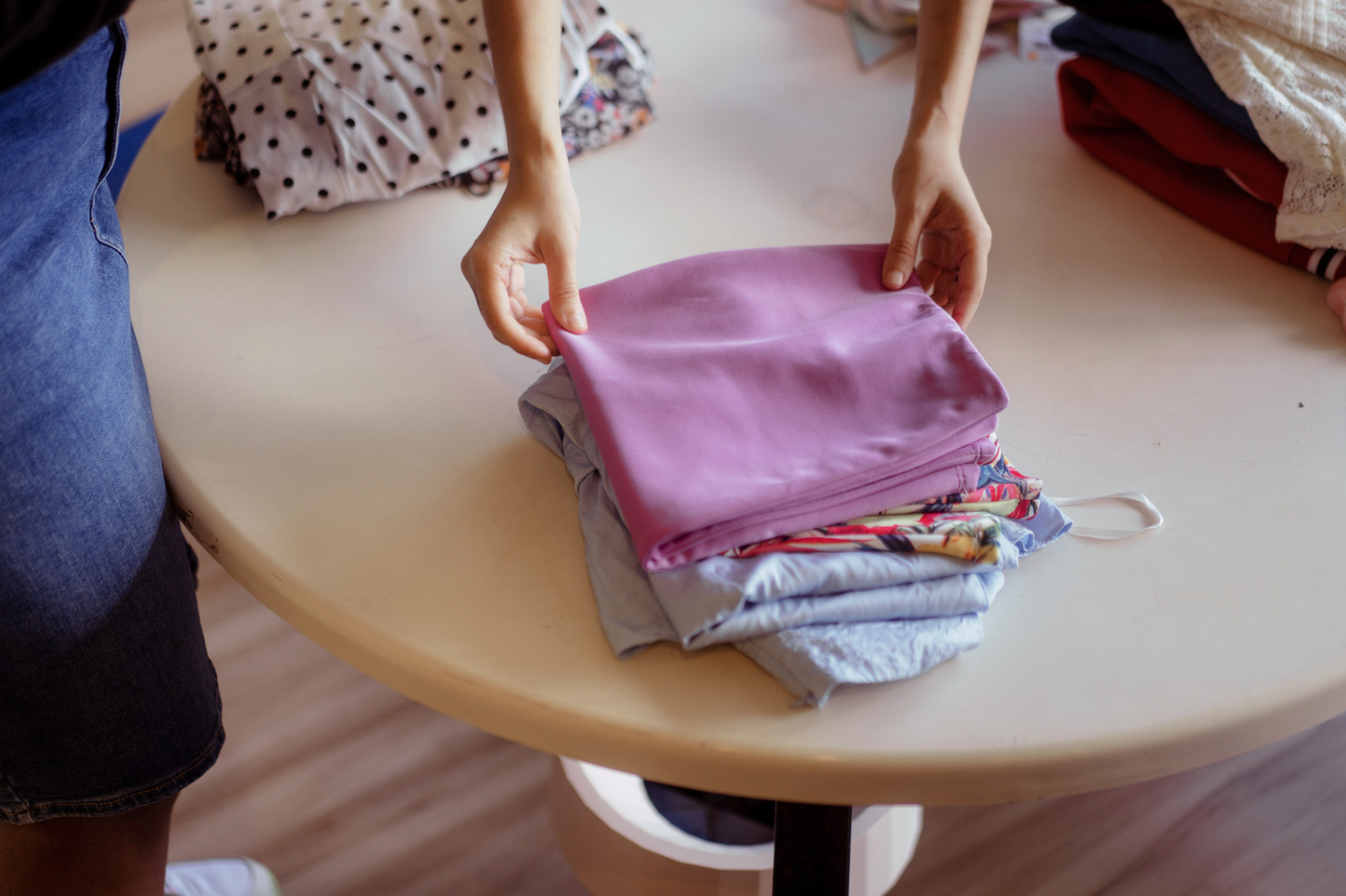
Emptying a closet or drawer completely allows you to see what you actually own. Sometimes the sheer quantity is revealing before you have made a single decision.
2. Pay attention to your response
Pick something up and pause before deciding whether it stays or goes.
Notice what arises.
Maybe there is affection. Maybe there is absolutely nothing. Maybe there is guilt, obligation, regret, or the familiar thought that you might need it someday.
You don’t have to treat every feeling as an instruction. The practice is simply to notice it.
3. Ask what you’re actually keeping
Sometimes we are keeping the object.
Sometimes we are keeping the money we spent on it.
Sometimes we are keeping the memory.
And sometimes we are keeping an idea of ourselves.
Simply noticing the difference can change the way we decide what stays.
4. Remember that the memory can stay
Letting go of an object doesn’t require letting go of what it represented.
The wedding still happened. Your children were still that small. You still took that trip. You still lived that version of your life.
The memory belongs to you, not the object.
5. Give with intention
Donation can change the experience of letting go.
An extra winter coat or sweatshirt sitting unused in our home could become something useful to another person. This has been particularly meaningful when decluttering with my children. Instead of focusing entirely on what they are losing, we can talk about where those things might go next.
Letting go can become an act of generosity rather than simply an act of removal.
6. Protect the space you create
This may be the part we overlook most.
After clearing a shelf, drawer, or closet, resist the urge to start filling up the empty space.
Leave some there.
Then notice how it feels.
The Value of Empty Space
We often treat empty space as unused space.
An empty shelf could hold something. An empty corner could use a chair. A half-full closet means there is room for more clothes.
But empty space has value of its own.
Our environments are part of the sensory landscape we move through every day. We may not need every room to be minimal or every surface to be bare. But we can become more intentional about what we allow to repeatedly enter our awareness.
Recently, I learned this in a rather unexpected way when a single moth led me to empty my entire closet. What began as a practical problem became a much bigger reflection on clothing, memory, guilt, identity, and why letting go can feel so emotional. I wrote that personal story in The Lemon Tree: What the Moth Left Behind.
That may be the part of decluttering I find most interesting. It isn’t simply deciding what to get rid of.
It is deciding what deserves to remain.
References
- Saxbe, D. E., & Repetti, R. L. (2010). No place like home: Home tours correlate with daily patterns of mood and cortisol. Personality and Social Psychology Bulletin, 36(1), 71–81.
- McMains, S. A., & Kastner, S. (2011). Interactions of top-down and bottom-up mechanisms in human visual cortex. Journal of Neuroscience, 31(2), 587–597.